
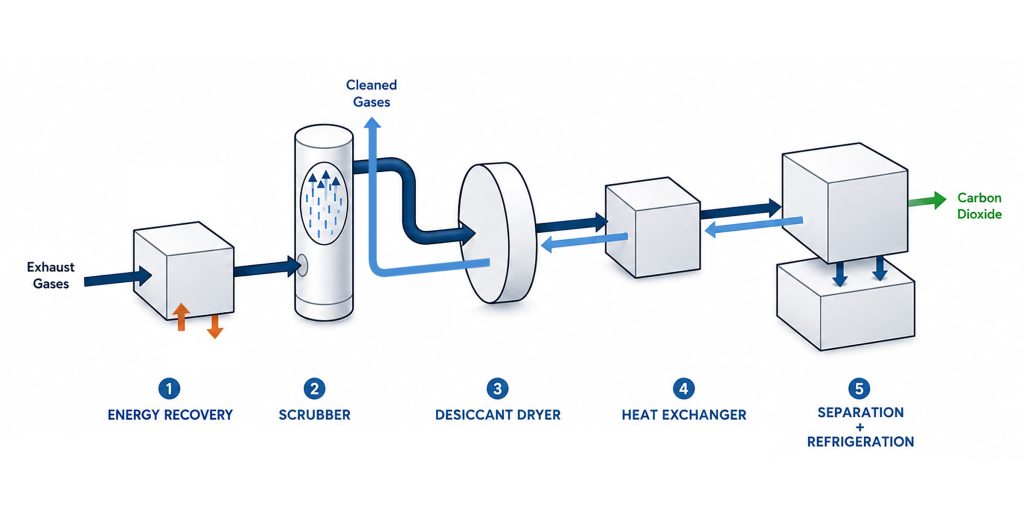
The A3C plant comprises the following steps:
- Energy recovery uses the high temperatures of the exhaust gases to provide energy to drive the separation process.
- Gas cleaning of gases removes traces of sulphur oxides and particulates in a low temperature scrubber.
- Drying and cooling reduces the water content to extremely low levels followed by a high-performance recuperative heat exchanger to cool the dry gases further. Efficient heat recovery techniques minimise refrigeration duty.
- Separation chills the gases sufficiently to freeze carbon dioxide onto a capture medium. This stage uses high intensity heat and mass transfer to capture carbon dioxide in a bed of capture medium only 200 mm deep.
- Liquid carbon dioxide is recovered from the capture medium without a separate liquefication train.
- An advanced and highly efficient refrigeration cascade provides the cooling for the separation process.
- The process inherently delivers extremely pure liquid carbon dioxide, meeting the exacting requirements of geological storage and reuse processes without further treatment.
- While the separation can achieve capture rates of up to 99%, for most applications rates above 90-95% are unlikely to be viable. Constraints on carbon dioxide storage for some applications may limit practical capture rates but this will not degrade energy efficiency.